
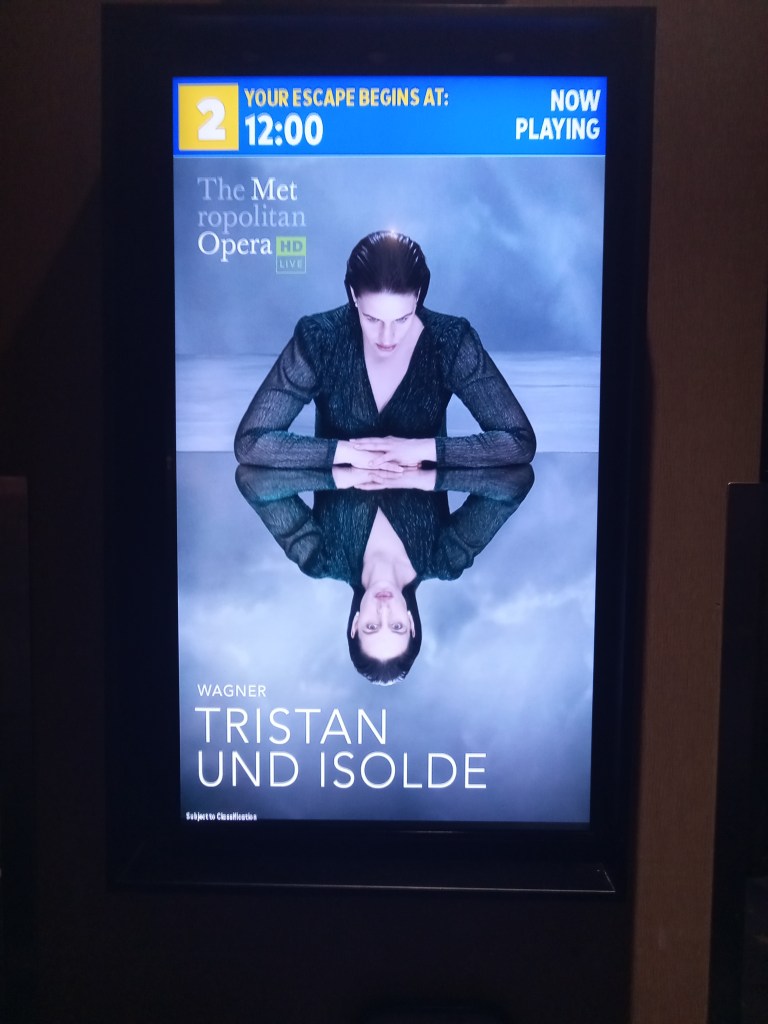
I attended the March 21st, 2026 Live in HD Broadcast of Richard Wagner‘s Tristan und Isolde from The Metropolitan Opera.
The production starts Michael Spyres and Lise Davidsen in the title roles along with Tomasz Konieczny (Kurwenal), Ekaterina Gubanova (Brangäne), Ryan Speedo Green (King Marke), and Thomas Glass (Melot.)
The Metropolitan Opera Orchestra was led by The Met’s Artistic Director, Yannick Nézet-Séguin. This new production is by Yuval Sharon, with sets by Es Devlin, and costumes by Clint Ramos.
The highlight of the production was the singing, led by Lise Davidsen. She was stunning in the role of Isolde. This is only her second production singing the role and she owned it. She is now on my on my list of top three Wagnerian sopranos (along with Kirsten Flagstad and Birgit Nilsson – all three Scandinavian, ironically.) Ms. Davidsen did not simply sing Isolde, she WAS Isolde from start to finish.
Mr. Green’s King Marke was moving – he sang and acted an extremely moving aria after discovering the lovers in Act II that heartbreaking.
Mr. Konieczny’s Kurwenal was tender and moving. He put 100% into the role and was exceptional, as was Ms. Gubanova’s Brangäne. Both characters were sympathetic and entirely loyal to the master and mistress.
Mr. Spyres, appearing in his first Tristan, was alright. He acted the role out well and for the most part sang adequately, although during the first two acts were were times I could clearly hear him holding back on some of the bigger notes and on a couple of occations during act two he was drowned out by the orchestra and Ms. Davidsen. He had some moments in Act III but still was not any better (I thought that he might have been pacing himself earlier in the opera in order to have enough energy to get through the third act.) I feel that it is unlikely that he will become one of my favourite Tristans as I feel the role is simply note suited for his voice, but he did manage to make it to the end of the performance which is hard enough to do in Tristan.
Mr. Sharon’s production had its’ moments but was also confusing for the most part. Each act opens with what looks like a closed camera lens with pieces that can be moved around. When opened, the singer generally stay in a cylindrical tube. It it shorter for the first act. But there is no clear ship for Act I, a castle in Acts II or III.
There are doubles for the title characters who were more of a distraction than a benefit who were at the front of the stage. Frankly, they didn’t add anything to the performance at all. I do not understand why Mr. Sharon included them.
During the first act, Isolde leaves the stage when Brangäne goes to to see Tristan. When she returns, Isolde walks back out on the stage and then claims she heard every word when it was clear that she did not hear the words because she was nowhere near where Brangäne , Kurwenal, and Tristan were. Plus there is no obvious ship (although projections around the tube did look like waves.) The only part of the staging in the first act that was intriguing was how the short duet between Tristan and Isolde was framed by what looked like a dagger – a reminder that they actually fell in love when Isolde had picked up Tristan’s sword and was going to stab him before he looked into her eyes which made her drop the sword – an action that place prior to the opera.
During the second act, it starts out with Isolde up front, and Brangäne in the tube. Isolde has a cheeky smile when she blows out the candle (flame.) For the duet, the singers remain in the tube, which at one point breaks into two pieces and moves back and forth and separating the lovers during their duet. Tristan also does run onto the stage at the start of the duet, but there are a couple moment of darkness after the candle is blown out in order for the singers to get up onto the tube. With the stirring music of Tristan running to Isolde, the stage direction is in direct competition to the music that Wagner wrote.
The end of the second act sees a long table, set up for dinner. The singers are all around the front of the stage with the table, the only time in the act where I could honestly say took place in a castle! This was the only scene which I honestly enjoyed overall.
The third act prelude sees Tristan’s double, Isolde, and Kurwenal on the stage. Tristan’s double in on the table again – the only suggestion of Tristan’s castle. Isolde departs before the end of the prelude. When the tube is revealed we see supernumeraries coming and going around on it. The English Horn player is dressed in white, along with the supernumeraries, and seen on stage. Tristan walks around the tube area. Between now and his death he will spend some of the time singing from the tube (which I imagine is supposed to be the afterlife) and on the table (changing places with his double who just walks off and on when changing places with Tristan.) The multiple moving of locations of Tristan made sense in one way (the director trying to show that Tristan was slowly dying and ‘moving onto’ the afterlife) but ended up being more of a distraction in the end.
When Isolde walks onto the front area of the stage she is clearly pregnant, even putting her hands around her ‘stomach’ to show her pregnancy. When the second ship arrives, Isolde leaves and her double comes out and takes her place. The double gets on the table and ends up delivering a baby on the stage. Ms. Davidsen ends the opera singing the Liebestod from the tube. Her Liebestod was moving and one of the best interpretations of this moving piece. She literally brought the house down with it.
The addition of a pregnant Isolde in Act III, whose double gives birth on the stage, ruined any chance of me liking Mr. Sharon’s production. Clearly he had no understanding of the opera when he added this and it was totally unnecessary. I ended up not liking the production itself after this.
The singing, overall, is the saving grace of this production.

 Edward Brain's Blog